
December 20, 2025
AI and energy: the dual green and digital transition in the EU
How AI is redefining European and Italian energy systems
Artificial intelligence is becoming one of the pillars of the European energy transition, but its adoption must be read in light of three intertwined dimensions: market, concrete use cases and EU regulatory framework. More and more analyses speak of a real “power couple” between AI and energy, in which energy systems become data‑driven and digital infrastructures are designed to support efficiency and decarbonization, not just new electricity demand.
An increasingly “AI‑native” Europe in energy
In recent years, Europe has decisively accelerated its “electrification”, progressively replacing fossil fuels with electrical energy in sectors such as transport, heating and industry. This dynamic, combined with the strong growth of wind and photovoltaic and with the increase of distributed generation, makes the system more complex to predict and control, creating natural ground for the adoption of AI solutions capable of managing large volumes of data in real time.
European Parliament and Commission highlight that the market for AI applications for energy is growing at double-digit annual rates, driven by investments in smart grids, demand response programs, digital twins for networks and plants and advanced platforms for consumption management in buildings and industrial sites, all key levers to meet the decarbonization objectives set by the Green Deal. In this framework, AI is explicitly recognized as an enabling technology to integrate growing shares of renewables, reduce network losses and improve efficiency along the entire energy supply chain.
On a global scale, McKinsey analyses show that AI adoption has now moved from the experimental phase to industrial scale: over 80% of large enterprises declare they use AI in at least one business function. Applications related to supply chain, operations and management of complex assets – such as those in the energy sector – are among the most profitable, because they allow optimization of flows, reduction of plant downtime, cutting energy waste and therefore reducing both operational costs and emissions.
IBM, in a study dedicated to the future of artificial intelligence and energy efficiency in utilities, notes that about three quarters of energy operators are already implementing AI and analytics solutions to leverage data from smart meters, IoT sensors and SCADA (Supervisory Control And Data Acquisition) systems. These projects aim to improve network reliability, anticipate failures and congestion, personalize offerings to customers and develop new digital services – from intelligent management of domestic loads to industrial flexibility contracts – transforming AI into a central competitive factor for the sector.
AI between renewables, networks and consumers
The most mature applications concern forecasting and management of renewable sources, dynamic management of networks and efficiency in end uses. In renewable generation, machine learning models improve the accuracy of wind and photovoltaic production forecasts by combining weather, historical and sensor data, reducing imbalances and system balancing costs; ENEA, for example, has developed an AI-based photovoltaic forecasting methodology that increases forecast precision and favors the integration of renewables in Italian microgrids.
On networks, AI supports operators in early detection of failures, in predictive maintenance of lines and transformers and in real-time optimization of energy flows, including coordinated management of distributed storage and electric vehicles. IBM studies on utilities in the AI era show how advanced algorithms are already used to optimize battery charging, predict local demand, reduce technical losses and improve customer service quality, paving the way for business models based on energy services and flexibility, in addition to the mere sale of kWh.
On the consumption side, AI enables advanced systems for building energy management, automated demand response services, personalized advice to customers and optimization of processes in energy-intensive industries. ENEA reports on energy efficiency document significant savings in Italy thanks to digitalization and intelligent control interventions in buildings and production processes, while IBM analyses emphasize how the use of smaller and specialized AI models can maximize the ratio between energy benefits obtained and computational consumption required.
The energy paradox of AI
This digital revolution presents an intrinsic energy paradox: AI that promises to optimize consumption and accelerate decarbonization in turn requires enormous computational resources, driving demand for electricity in strong expansion located mainly in data centers and HPC (high-performance computing) systems. The IEA estimates that global data center consumption could more than double by 2030, rising from about 460 TWh in 2022 to over 1,000 TWh, with generative AI as the main driver of this growth – an additional requirement equivalent to the annual consumption of several European countries, which will put pressure on transmission networks, generation mix and infrastructure investment plans.
However, the net balance is not inevitably negative: in its commentary “Why AI and energy are the new power couple”, the IEA highlights how widespread adoption of AI along the energy supply chain – from smart grids to building management, industrial processes and mobility – can generate systemic savings and emissions reductions capable of compensating, and in optimistic scenarios exceeding, the increase in demand from data centers. The essential condition is “energy-aware” design: algorithms that schedule computational loads based on renewable availability, optimized hardware and governance that prioritizes efficiency on an infrastructural scale.
In this direction, IBM proposes concrete solutions to mitigate the impact: more efficient hardware such as optical chips that drastically reduce consumption per computational flop; dynamic power capping techniques capable of cutting server consumption by up to 15% while maintaining acceptable performance; and specialized small language models (SLM) AI models, which offer sectoral value (e.g. energy forecasting or predictive maintenance) with an energy footprint up to 100 times lower than large generalist LLMs. These innovations not only balance the paradox, but transform AI itself into a tool to optimize its own consumption, closing the circle towards a truly sustainable energy transition.
The European Union’s response
The European Parliament has dedicated a specific analysis to the relationship between AI and the energy sector, emphasizing the “bi‑directional” character of this transformation:
on one hand AI increases electricity demand and requires new investments in generation and networks;
on the other it is an essential tool to improve efficiency, renewable integration and infrastructure management.
In the broader regulatory framework, the AI Act and future European regulations on cloud, data centers and digital infrastructures aim to ensure that high-impact systems, including those for energy management, meet requirements for safety, transparency and, increasingly, energy efficiency and environmental reporting.
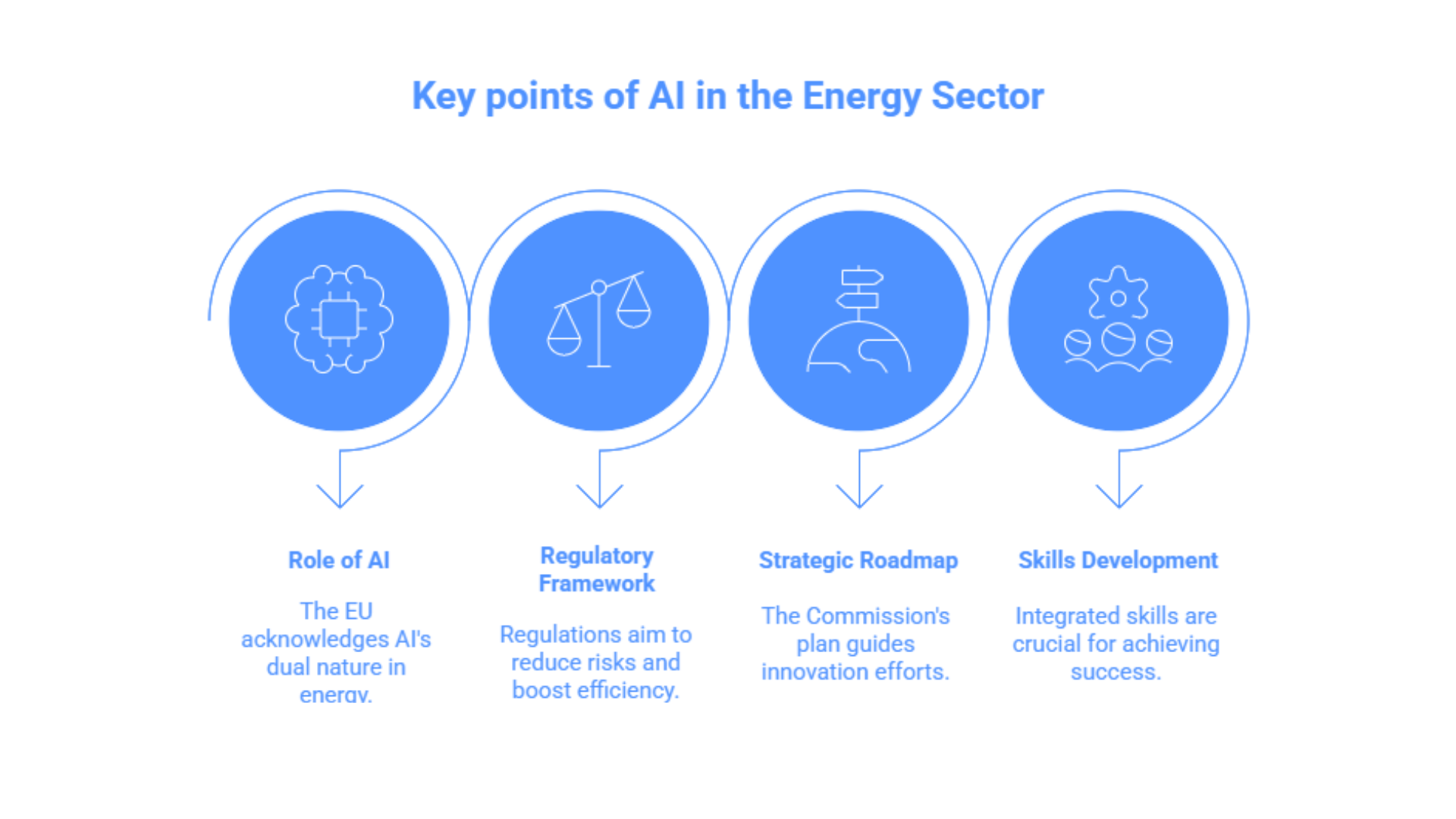
Alongside regulation, the Commission is building a strategic roadmap for digitalization and AI in the energy sector, with the objective of accelerating the adoption of European digital solutions in areas such as network optimization, efficiency in buildings and industry, demand-side flexibility and digital twins of electrical infrastructures. In parallel, European research institutes and think tanks highlight how the success of this path depends on the ability to develop integrated skills between energy systems engineering, data science and data governance, so as to transform the growing mass of energy information into operational decisions and investments consistent with climate objectives.
Italy between experimentation and European policy
In the Italian context, the digital transformation of energy systems is linked to the strong growth of renewables – which in 2024 exceeded 40% of electricity production – the widespread diffusion of smart meters (over 32 million installed) and the need to make networks and services smarter and more reliable. Pilot projects such as Terna and Enel’s smart grids, the management of energy communities in Lombardy and Emilia-Romagna, the use of AI to predict solar production, anticipatory maintenance of infrastructures and new services for families and businesses show a sector in full expansion, often part of European programs and financed by the PNRR.
For Italian utilities, ESCos and tech SMEs, AI is a real competitive opportunity: it helps optimize production and purchases by reducing errors by 10-20%, creates extra services such as platforms to manage industrial consumption (flexibility agreements with ARERA) and generates revenue from energy data. Examples such as Enel X’s AI for smart charging and domestic storage, or Italgas’ digital models for gas networks, make Italy a European testing ground for AI and renewables.
The key remains developing internal skills: managing energy data autonomously, bringing together engineers, data experts and regulators (AI Act, NIS2), following EU standards on data sharing (e.g. Gaia-X) and digital sustainability. This way Italy can transform the green and digital transition into a European competitive advantage.
Sources:
International Energy Agency (IEA), Energy and AI – Special Report. https://www.iea.org/reports/energy-and-ai
International Energy Agency (IEA), “Why AI and energy are the new power couple”. https://www.iea.org/commentaries/why-ai-and-energy-are-the-new-power-couple
European Parliament, Research Service, “AI and the energy sector”. https://www.europarl.europa.eu/thinktank/en/document/EPRS_BRI(2025)775859
European Commission, Artificial intelligence unlocking a smarter, greener energy future and initiatives on digitalization of energy systems and data centers. https://digital-strategy.ec.europa.eu/en/library/artificial-intelligence-unlocking-smarter-greener-energy-future
IBM, The future of artificial intelligence and energy efficiency. https://www.ibm.com/it-it/think/insights/future-ai-energy-efficiency
McKinsey, The state of AI in 2025 and analysis on data centers and energy requirements for AI. https://www.mckinsey.com/capabilities/quantumblack/our-insights/the-state-of-ai
ENEA, Annual Report on Energy Efficiency 2025 and projects on AI-based photovoltaic forecasting. https://www.efficienzaenergetica.enea.it/pubblicazioni/raee-rapporto-annuale-sull-efficienza-energetica/rapporto-annuale-sull-efficienza-energetica-2025.html
I‑Com, DARE ENERG‑IA ALL’ITALIA and other studies on AI and energy transition. https://www.i-com.it/wp-content/uploads/2025/11/Rapporto_Energ-IA.pdf

Marta Magnini
Digital Marketing & Communication Assistant at Aidia, graduated in Communication Sciences and passionate about performing arts.

At Aidia, we develop AI-based software solutions, NLP solutions, Big Data Analytics, and Data Science. Innovative solutions to optimize processes and streamline workflows. To learn more, contact us or send an email to info@aidia.it.


Latest news

September 30, 2026
AI token costs: why being able to switch models matters

September 24, 2026
AI audit trails: what changes under Legislative Decree 160/2026

September 21, 2026
What is enshittification?